How much does video dubbing cost?
Real price ranges for traditional dubbing, AI dubbing and the options in between, plus the hidden costs and a quick way to work out your own budget.
6 min read
“How much does it cost?” is the first question anyone asks about dubbing, and it’s the one with the least useful answers online. Studios quote per project. Software companies quote per month. Neither tells you what a ten-video series in three languages will cost you.
So let’s do it properly. This article covers what the different approaches cost, what drives the number up, and how to estimate your own total. A caution before we start: pricing in this market changes often, and published figures mostly come from vendors with something to sell. Treat every number here as a range and confirm with current quotes.
The short answer
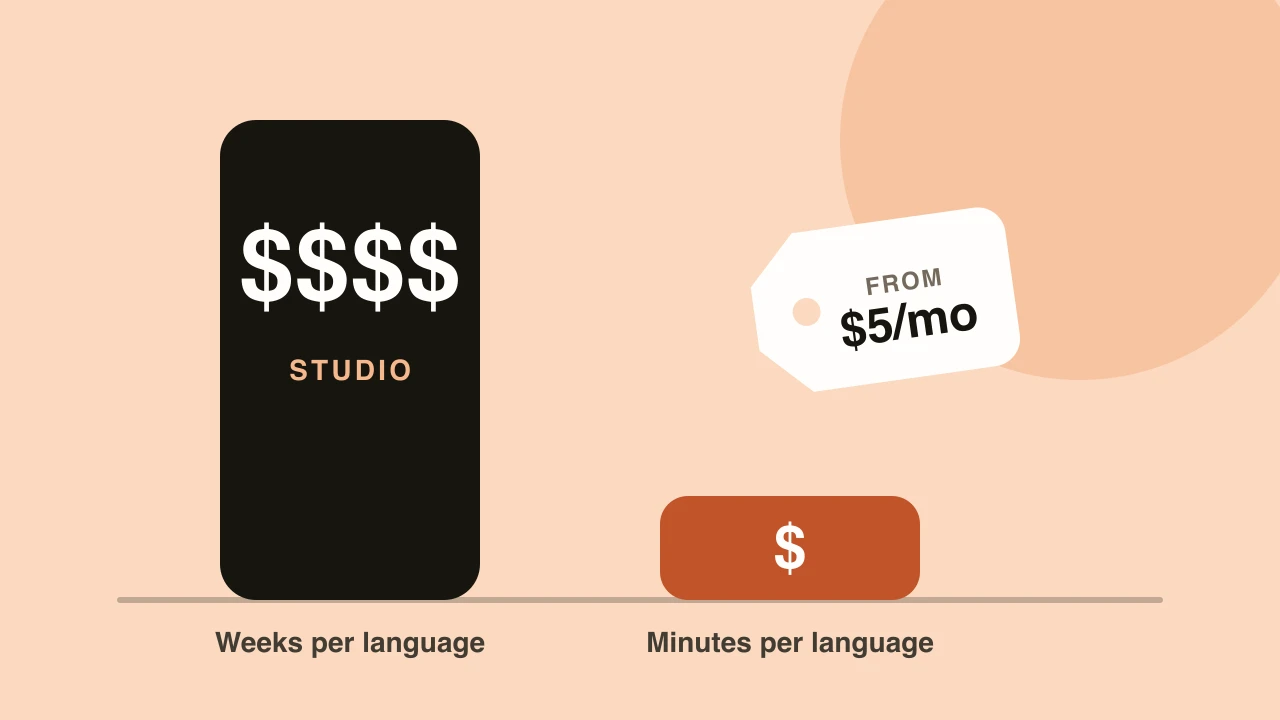
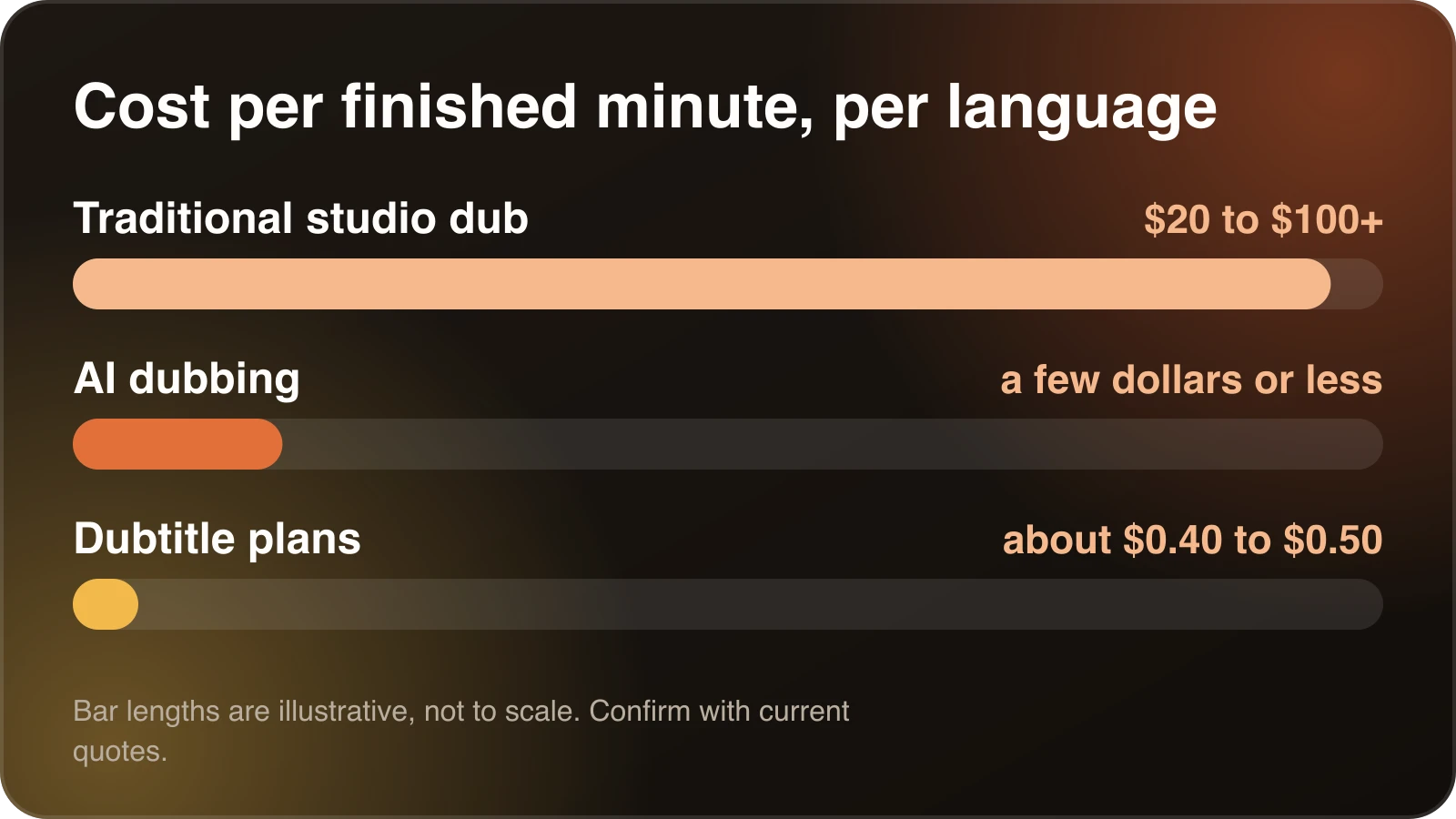
For a human-voiced dub from a professional studio, published ranges generally land somewhere between about $20 and $100 or more per finished minute, per language, with premium work such as lip-synced dubbing for film and TV at the top end and more. Some sources quote far higher figures for full productions.
For AI dubbing, per-minute costs are typically a small fraction of that, often quoted at a few dollars a minute or less, depending on the tool and plan.
That gap is the story. The detail below is about whether it applies to you.
The four options
1. Traditional studio dubbing
This is how films and large corporate projects are dubbed. A translator or adapter writes a script that fits the timing of the original. A director casts voice actors. The actors record in a studio, engineers edit and mix the audio, and a reviewer checks the result.
What drives cost:
- Number of actors and how experienced they are
- Studio time and engineering
- Script adaptation (more than literal translation)
- Language: some languages have a smaller talent pool
- Usage rights, which vary by use and territory
- Revisions: a script change can mean re-recording
Timeline: commonly a few weeks per language.
Best for: flagship productions where performance is part of the creative work. A brand film, a drama, a high-stakes launch.
2. Freelance voiceover plus translation
A middle route. You hire a translator and a freelance voice actor, then edit the audio into the video yourself or with an editor.
What drives cost: the translator’s per-word rate, the voice actor’s per-finished-minute or per-session rate, and editing time. It’s cheaper than a full studio but far more work for you, since you’re the producer.
Best for: a small number of important videos in one or two languages.
3. AI dubbing
Software transcribes the speech, translates it, and generates a dubbed voice, often cloned from the original speaker. It’s usually sold as a subscription with a monthly allowance of minutes, though some tools charge by credits or per minute.
What drives cost: how many minutes you dub, how many languages, which plan you choose, and whether extras like lip-sync are charged separately.
Timeline: minutes. Dubtitle videos typically process in 2 to 10 minutes.
Best for: creators, courses, training, product and marketing video, and any case with volume.
4. Hybrid
AI for the bulk and humans where it counts. For example, AI-dub your course library and have a native speaker review the first modules. Or AI-dub everything and use a studio for the one flagship video.
For many teams this ends up being the most sensible approach, because it puts human money where it changes the outcome.
What Dubtitle costs
Because it’s the one we can speak to precisely, here are Dubtitle’s plans as of this writing. Check the pricing page for current numbers.
| Plan | Monthly price (USD) | Dubbing minutes |
|---|---|---|
| Free trial | $0 | 5 minutes, 7 days, watermarked, up to 60 seconds per video |
| Starter | $5 | 10 minutes |
| Creator | $22 | 45 minutes |
| Professional | $45 | 100 minutes |
| Scale | $99 | 250 minutes |
That works out to roughly 40 to 50 cents per included minute, depending on the plan. Custom translation glossaries come with Creator and above. Every paid plan has a 30-day money-back guarantee.
The part everyone forgets: languages multiply
Here’s the calculation that catches people. A ten-minute video dubbed into three languages isn’t ten minutes of work. It’s thirty minutes of output.
If you’re comparing tools, find out exactly how each one counts this. Some count each language as separate usage. Check how the plan you’re considering does it, and when in doubt, plan as though each language uses its own minutes.
The formula for a rough monthly need:
minutes of video × number of languages × a re-run allowance
For the re-run allowance, add 20 to 30 per cent if you’re new to this. You’ll regenerate some lines after review, and it’s better to budget for it than to be surprised.
Worked examples
These are illustrations, not quotes.
A YouTuber dubbing four 8-minute videos a month into Hindi. 4 × 8 = 32 minutes. One language. Add 25% for re-runs: about 40 minutes. That fits comfortably within a plan with 45 minutes.
An instructor localizing a 3-hour course into Spanish and Portuguese. 180 minutes × 2 languages = 360 minutes, as a one-off project. Spread over a couple of months on a higher plan, or a single month on a larger one. Compare that with studio quotes for 3 hours of narrated content in two languages, and the contrast is plain.
A company dubbing a 90-second product video into 10 languages. 1.5 minutes × 10 = 15 minutes. That’s within a small plan. A studio quote for ten languages, even for a short film, would be many times higher.
Costs people forget
Whatever method you choose, the sticker price rarely covers the full bill.
Review. A native speaker checking the translation. For AI dubbing, this is your largest remaining cost. It might be an hour or two per language for a short video, or a spot-check plan for a course. Budget something even if only modestly.
Subtitles and on-screen text. Dubbing the voice doesn’t change slides or captions baked into the picture.
Packaging. Translated titles, descriptions, thumbnails and sales pages.
Revisions. Studios charge for re-recording. With AI, edits are cheap, but your time isn’t free.
Support. If you’re selling in a new language, someone needs to answer customer questions in it.
Tool overlap. If you’re paying for several subscriptions to compare them, cancel what you don’t use.
When traditional dubbing is worth it
We don’t think AI is the right answer for everything. Pay for human dubbing when:
- The performance is the product: drama, animation, comedy.
- The brand risk of an off-sounding line is high.
- Regulations or contracts require certified or human-reviewed translations.
- Talent identity matters, for example when you need a well-known actor’s voice.
If your content is explainer, educational, product or channel video, the question is usually how much human review to add, not whether to hire actors.
Ways to keep the bill down
- Start with one language. Learn from it before scaling.
- Fix the source first. Edit the original before dubbing, not after.
- Use a glossary. It reduces review time more than almost anything else.
- Dub your best content first. Spend minutes where payoff is likely.
- Test on a short clip. A free trial costs nothing, and you’ll see where the problems are.
- Review in text. Reading a translated transcript is faster than listening to every line.
A simple budgeting method
- List the videos you want dubbed and their total length in minutes.
- Multiply by the number of languages.
- Add 25% for re-runs.
- Compare the total with a plan’s included minutes, and decide whether one month of a bigger plan or several months of a smaller one works better.
- Add a line for human review.
- Compare the whole figure with a studio quote for the same job, if you want the contrast.
If you want to see where your numbers land, start a free trial and dub a short clip. Then use the pricing page to match your volume to a plan.
Frequently asked questions
How much does it cost to dub a video?
Professional human dubbing is commonly quoted at roughly $20 to $100 or more per finished minute, per language. AI dubbing typically costs a few dollars a minute or less. Dubtitle plans start at $5 a month for 10 minutes, which works out to roughly 40 to 50 cents per included minute.
How much does AI dubbing cost per minute?
Most AI dubbing tools land well under a few dollars per minute. On Dubtitle, per-minute cost falls as you move up plans, from about 50 cents on Starter to roughly 40 cents on larger plans.
Why does dubbing into more languages cost more?
Every language is a separate dub, so the cost multiplies by the number of languages. Budget per language, not per video, and start with the one or two languages where you have the most viewers.
Is there a free way to try AI dubbing?
Dubtitle has a 7-day free trial with 5 minutes of dubbing. Trial videos are watermarked and capped at 60 seconds each. Paid plans have a 30-day money-back guarantee.
When is traditional dubbing worth the extra cost?
When you need acting performance, lip sync for film or TV, or broadcast-level sign-off. For tutorials, courses, product videos and creator content, AI dubbing is usually the practical choice.