ElevenLabs alternative for video dubbing
When a video-first dubbing platform fits better than a voice generation platform, how the two differ and how to compare ElevenLabs alternatives.
6 min read
ElevenLabs is well known for voice generation. Many people who search for an ElevenLabs alternative are not unhappy with the voices. They want something built for video, where the finished result is a dubbed video and not a set of audio files to assemble. This guide explains the difference and how to compare options fairly.
A voice engine and a video platform
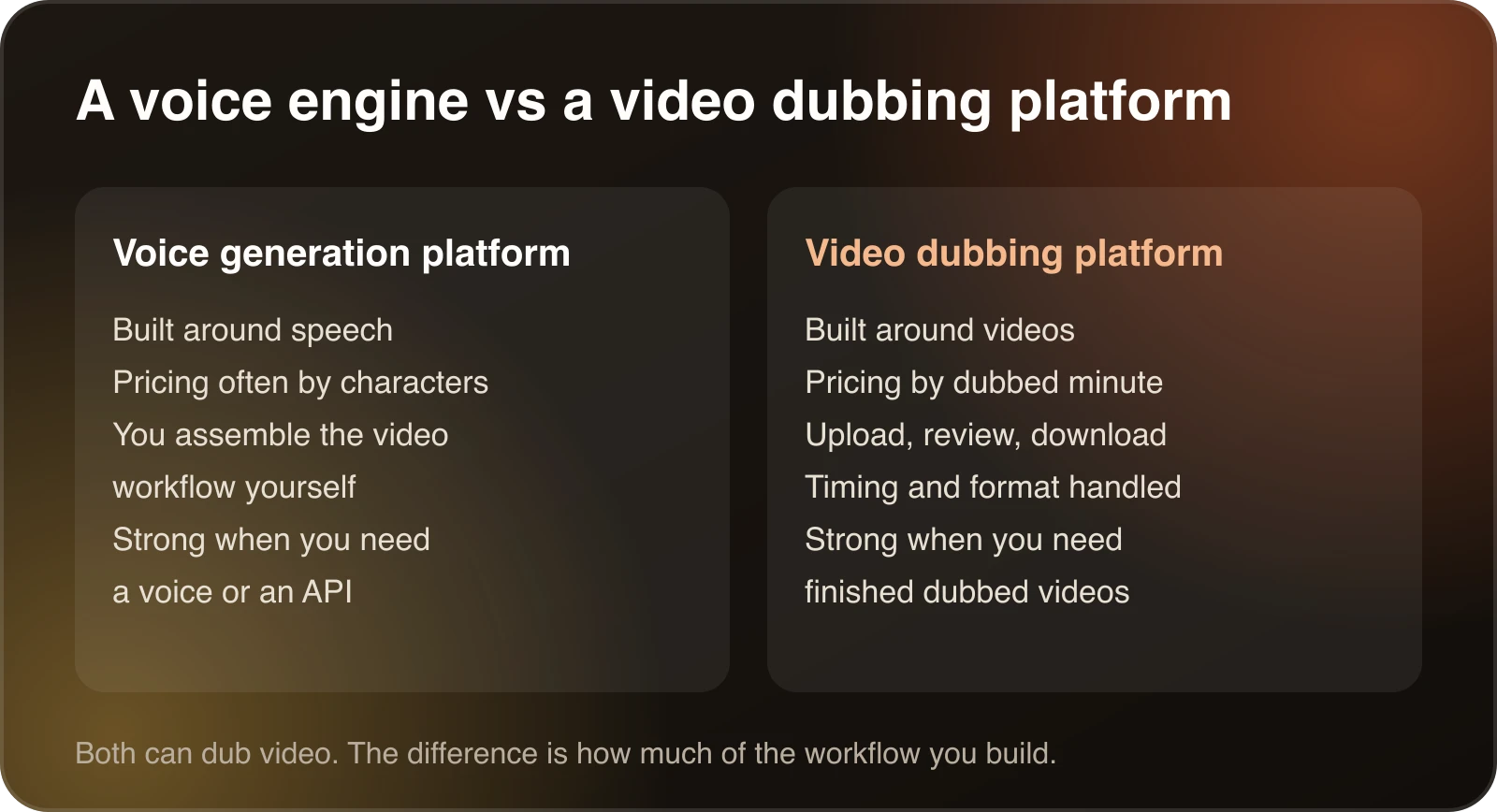
A voice generation platform is built around speech. It gives you a voice or an API, and you assemble the video workflow yourself: extracting audio, timing the new speech to the scenes, mixing it back and exporting.
A video dubbing platform is built around the finished video. You upload the file, choose a language, review the translation and download a dubbed video. Timing, format handling and project management are part of the product.
Dubtitle is a video-first platform built on ElevenLabs voice technology, with its own dubbing methods on top for timing and video output.
Why creators choose a video-first option
Video-first design. Dubtitle handles timing synchronization, format compatibility and video output, so you do not build those yourself.
Predictable pricing. Plans are sold by dubbed minute, which is easier to budget for video than character-based billing. Dubtitle can cost up to 50% less for video work, though the right comparison is your own volume.
One platform. You do not need extra tools for timing, synchronization or format conversion.
Creator features. Project management, batch work and direct video output suit people who dub many videos. In Studio you edit any translated line and regenerate only that segment.
No integration work. An API needs development time. A ready-made platform does not.
Who benefits
YouTubers and creators who want to reach new markets while keeping their own voice. AI dubbing for YouTube shows the workflow.
Marketing teams that localize campaigns and need the brand voice to stay consistent across markets.
E-learning providers that want course content in several languages with stable terminology. See how to localize online courses.
Filmmakers and studios distributing to international audiences without the cost of a traditional dubbing studio.
The workflow in Dubtitle
- Upload your video or import it from a link. Dubtitle supports MP4, MOV, AVI and MKV files and handles format optimization and audio extraction.
- Select a language. Choose from 84 languages. The tool preserves voice characteristics and emotion.
- Let it process. Most videos finish in 2 to 10 minutes.
- Review and download. Fix any line you do not like and download the dubbed video.
Voices and migration
Voice cloning generates the dub in a voice modelled on the original speaker, so tone and pacing carry across languages. How to preserve a speaker’s voice explains how to get a clean result. If you already use ElevenLabs voice profiles, Dubtitle supports custom voice profiles and brand audio assets, so you can keep a consistent voice identity. Contact the team to move an existing setup. Only clone voices you own or have permission to use.
What changes in your day to day
Take a creator with a ten minute tutorial who wants it in Spanish and Hindi.
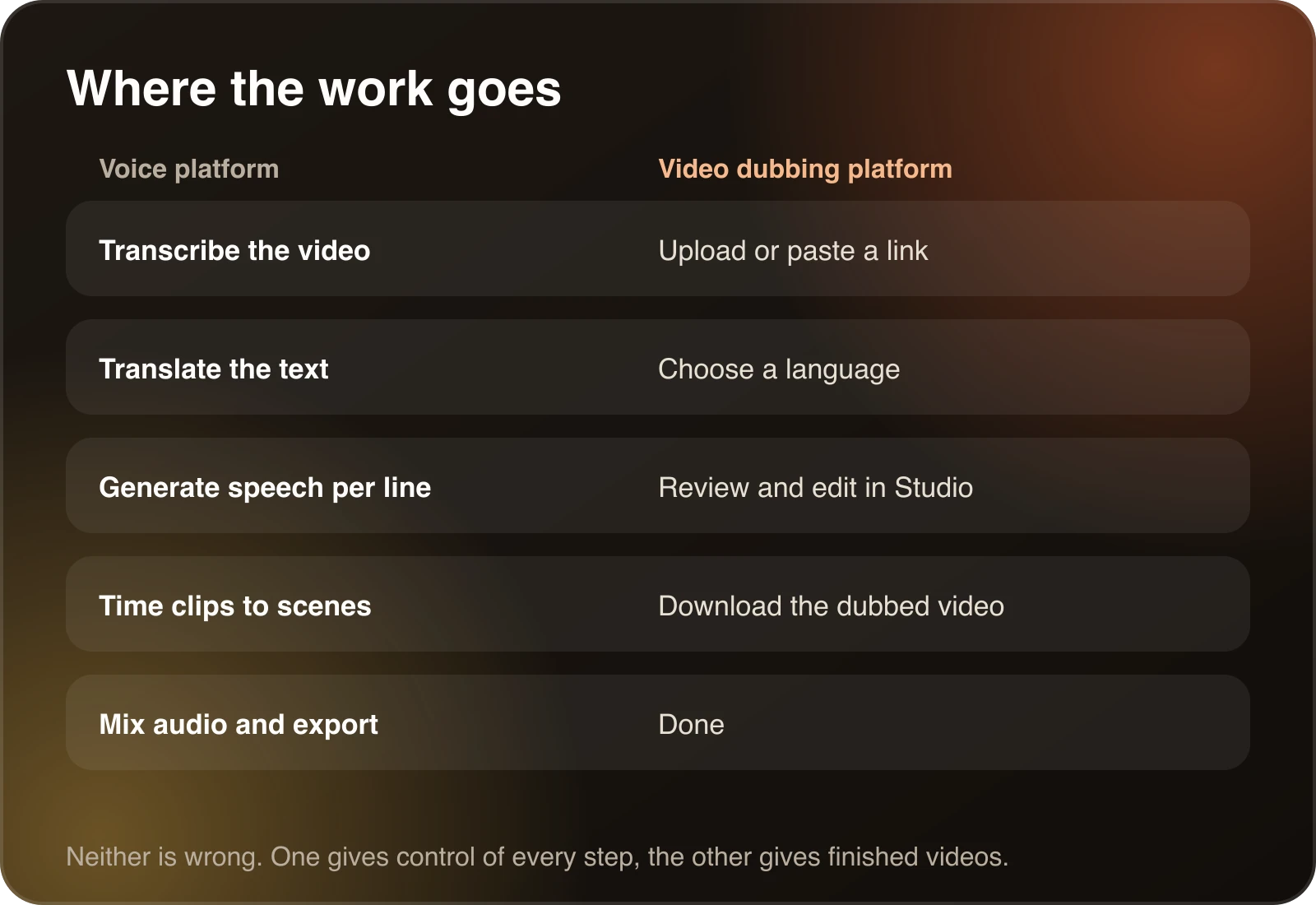
On a voice platform, the work looks like this. You transcribe the video, translate the text, generate speech for each line, check the length of every clip against the scenes, mix the audio back into the video, export, and repeat for the second language. Each step is something you manage, or something you build.
On a video-first platform, you upload the file, choose Spanish and Hindi and start the job. The tool handles transcription, translation, voice, timing and export. You open Studio, read the transcript, fix a product name or an idiom, regenerate that line and download the finished videos. The time you spend goes into review, which is where quality actually comes from.
Neither approach is wrong. The first gives you control of every step. The second gives you finished videos with less setup. The right choice depends on whether you want to build a pipeline or dub videos.
Pricing: characters versus minutes
Character-based pricing is common for voice platforms. It makes sense for speech generation, but it is hard to predict for video because the number of characters depends on language, speaking pace and how much of the video is speech. Per-minute pricing maps directly onto the thing you are producing, which is minutes of dubbed video.
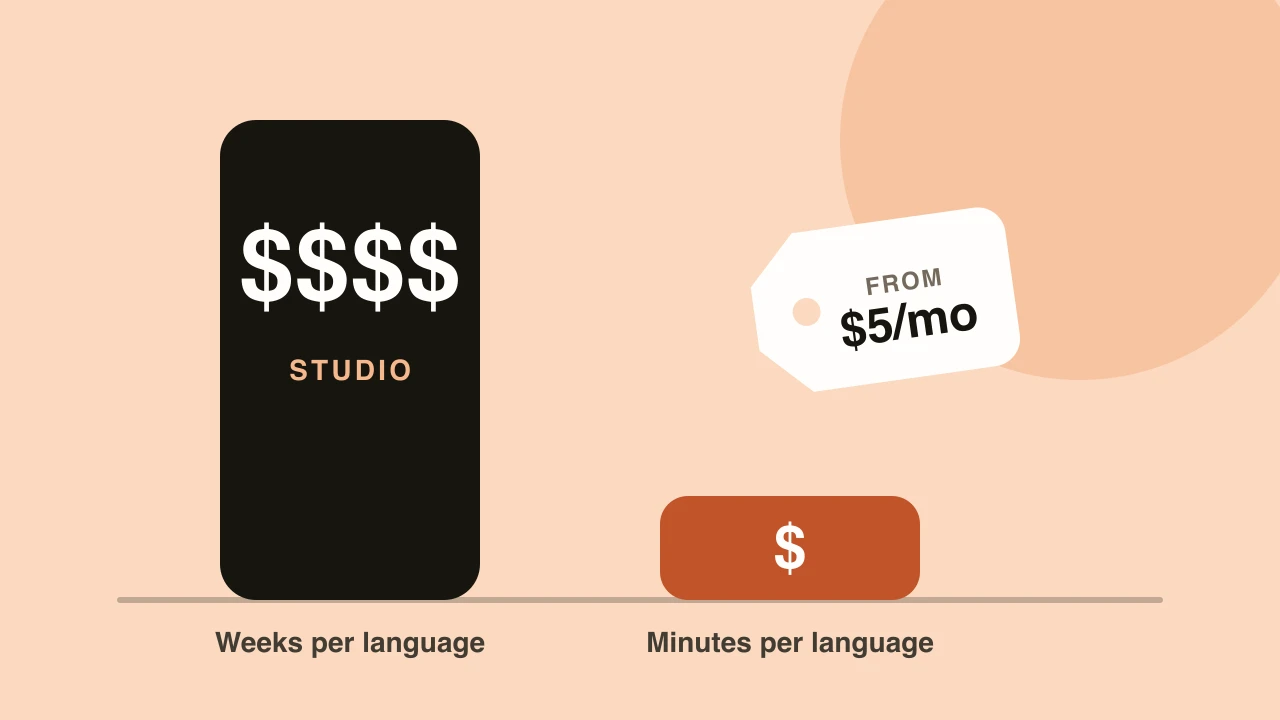
Dubtitle plans are sold by dubbed minute and start at $5 a month. Dubtitle can cost up to 50% less for video work, but the honest comparison is on your own numbers. Estimate your monthly minutes, check each vendor’s current pricing and divide to get a cost per finished minute per language. The cost guide walks through that calculation, and it also compares AI dubbing with traditional studio dubbing.
Questions to ask any vendor
- Can I read and edit the translation before the voice is generated?
- Can I fix a single line without redoing the video?
- Can I set how product names and recurring terms are translated?
- How is usage counted, and what happens if I go over?
- Does the free trial cover my languages, and does it add a watermark?
- What are the rules on cloning a voice, and who owns the result?
How to compare ElevenLabs alternatives
- Pick one real clip from your own footage.
- Use the same language pair everywhere.
- Read the transcript and count mistakes in names and terms.
- Listen to the voice and check pacing against the scene.
- Time the whole job. Count the manual steps you have to do yourself.
- Work out cost per finished minute at your expected volume.
Dubtitle has a 7-day free trial with 5 minutes of dubbing for videos up to 60 seconds, with a watermark. That is enough to run the test.
When a voice platform is the better choice
If you need a voice for audiobooks, apps or games, or you want to build your own video pipeline through an API, a voice platform gives you more flexibility. A video-first platform fits when the goal is a finished dubbed video with the least setup. Check each vendor’s current features, since this market changes quickly.
A short checklist
- Decide whether you need a voice or a finished dubbed video.
- Pick one real clip and run it through each option.
- Count the manual steps you have to do yourself.
- Compare cost per finished minute, not the headline price.
- Check that you can edit the translation and fix single lines.
- Confirm the rules on cloning and using voices.
Related reading
For a wider view, read best AI video dubbing software and the AI video translator guide. If you are weighing avatar tools too, see the HeyGen alternative guide. How much video dubbing costs helps you work out a budget, and pricing lists every plan.
Frequently asked questions
Why choose Dubtitle over ElevenLabs for video dubbing?
Dubtitle is built around video. ElevenLabs excels at voice generation. Dubtitle combines voice quality with a video-first workflow, a Studio editor, glossaries and plans sold by dubbed minute.
Does Dubtitle match ElevenLabs voice quality?
Dubtitle is built on ElevenLabs voice technology and adds its own video dubbing methods, such as timing and format handling.
How does Dubtitle pricing compare with ElevenLabs for video?
ElevenLabs commonly prices by characters, which can be hard to predict for video. Dubtitle sells plans by dubbed minute and can cost up to 50% less for video work. Compare on your own volume. See pricing and the cost guide.
Can I move my ElevenLabs voice profiles to Dubtitle?
Dubtitle supports custom voice profiles and brand audio assets so you can keep a consistent voice. Contact us for help moving an existing setup.
Do I need to write code to use Dubtitle?
No. Dubtitle is a ready-to-use platform. You upload a video, choose a language, review and download.
What else should I compare?
Compare on your own footage and languages. The best AI video dubbing software guide and the HeyGen alternative guide cover other kinds of tool.
Table of contents (12)
- A voice engine and a video platform
- Why creators choose a video-first option
- Who benefits
- The workflow in Dubtitle
- Voices and migration
- What changes in your day to day
- Pricing: characters versus minutes
- Questions to ask any vendor
- How to compare ElevenLabs alternatives
- When a voice platform is the better choice
- A short checklist
- Related reading